

Gold Price Update: What Happened in May 2026 (And How to Know What Your Gold Is Actually Worth)
- Keyhan Exchange
- Market News
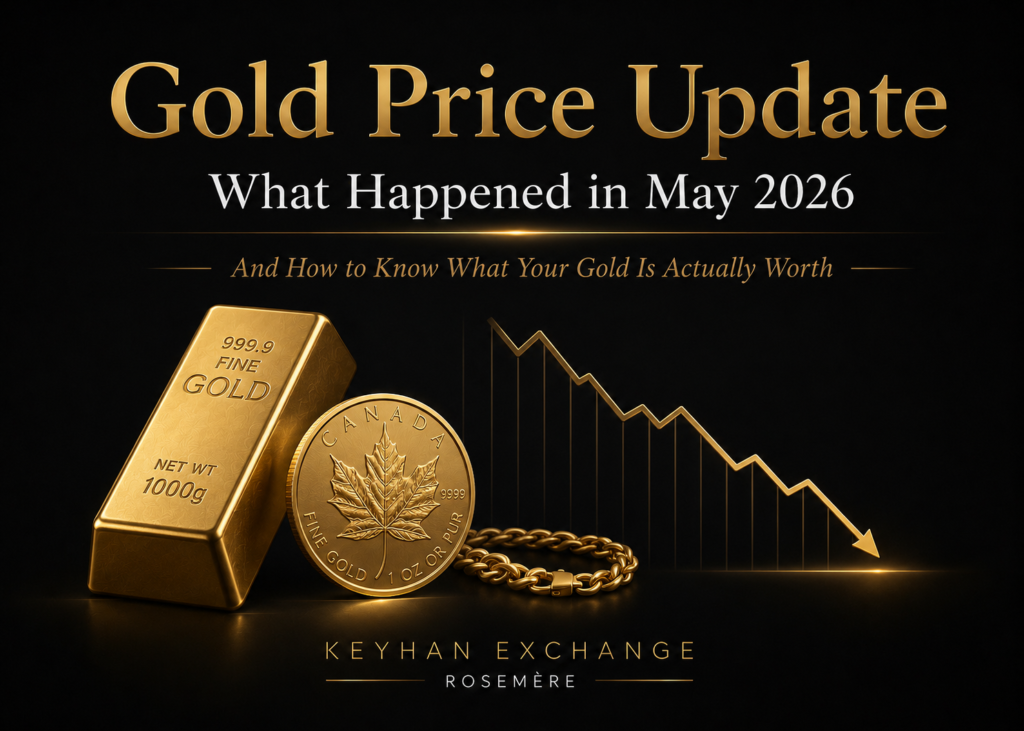
Short answer: The gold price fell through much of May 2026. On May 29, the last trading day before the weekend, gold closed around $4,495 to $4,524 per ounce depending on the provider, while Yahoo Finance reported futures touching as high as $4,560 intraday that same morning. That left gold down close to a fifth of its value from its all-time record, set in late January 2026 at a price most major trackers place between $5,589 and $5,602 per ounce, depending on the data provider and the exact moment used. The drop in May was driven by a stronger US dollar, rising bond yields, and shifting expectations around US Federal Reserve interest rate policy. If you're holding gold jewelry, coins, or scrap and wondering what it's actually worth, the second half of this guide walks through exactly how that number gets calculated.
Part 1: The Gold Price in May 2026
The gold price spent most of 2026 adjusting to a single, dramatic event from earlier in the year. Understanding May means understanding what came before it.
Where gold started: a record high, then a fast correction
Gold hit an all-time high in late January 2026. The exact figure depends on which data provider and pricing basis you check: APMEX places it at $5,602.22 per troy ounce on January 28, while other trackers, including TradingView and Bloomberg-sourced reporting, put the peak closer to $5,589 to $5,595 on January 29. That kind of small variance between providers is normal and usually comes down to time zones, exchange differences, or whether spot or futures pricing is used. Whichever exact figure you use, the record followed a sharp run-up driven by escalating tensions tied to the US-Iran conflict, a weakening US dollar, strong retail investment demand out of Asia, particularly China, and persistent inflation concerns.
The correction that followed was fast. By mid-2026, multiple market trackers, including TradingEconomics and J.P. Morgan Global Research, described gold trading in the $4,100 to $4,700 range, down sharply from the January peak. As a result, by the time May began, gold had already given up a meaningful share of its record-high value.
What actually happened during May
May continued that downward pressure into the final trading day before the weekend. On Friday, May 29, GoldPrice.org recorded a close of $4,495.57 per ounce, up $48.04, or 1.07%, on the day. Other trackers showed a higher level that same morning: Yahoo Finance reported August gold futures opening at $4,527.60, then climbing to $4,560.40 by 6:27am ET as reports circulated of a possible 60-day truce extension between the US and Iran. Pricing data for the following days showed gold easing into the $4,515 to $4,536 range as the month closed out on Sunday, May 31. Differences like these between providers are normal and usually come down to whether the quote is spot or futures, the exact timestamp, and whether weekend pricing is shown at all, so treat any single exact number for "the close" with some flexibility.
The main pressure came from a stronger US dollar, rising bond yields, and shifting expectations that the Federal Reserve would keep interest rates higher for longer. Because gold is priced in US dollars globally, a stronger dollar makes gold more expensive for buyers using other currencies, which tends to soften demand and pull the price down. Inflation data added to that pressure: Yahoo Finance reported that the Fed's preferred inflation gauge, the Personal Consumption Expenditures Index, rose 3.8% in April, a three-year high driven largely by the war in Iran, which reinforced expectations that the Fed would hold rates steady at its mid-June meeting rather than cut. At the same time, hope that a 60-day US-Iran truce extension might reopen the Strait of Hormuz gave gold a brief lift on May 29 itself, a reminder that even within a single down month, the daily direction could swing on a single headline.
The bigger picture for May
Even after the May decline, gold remained part of what J.P. Morgan Global Research described as a longer-term structural story, not just a short-term trade. Central banks bought a net 244 tonnes of gold during the first quarter of 2026, according to World Gold Council data, while bar and coin investment demand, led by Asian buyers, jumped 42% year-over-year. Combined, global gold demand reached a record US$193 billion in value during that quarter, the World Gold Council reported. In other words, May's price drop reflected short-term positioning and currency strength, layered on top of a longer-term demand picture that several major banks still consider intact.
Part 2: How Much Is Your Gold Actually Worth?
Headlines about the gold price tell you what's happening in the broader market. They don't tell you what a ring, a chain, or a handful of old coins sitting in a drawer is actually worth. That number depends on three specific things. Once you understand how they fit together, you can walk into any gold buyer with a realistic expectation of what you should be offered.
The three things that determine your gold's value
Purity, or karat. Pure gold is 24 karat, but most jewelry is mixed with other metals for durability, so it contains less than 100% actual gold. The common karats and their approximate gold content are:
| Karat | Approximate purity |
|---|---|
| 24K | 99.9% pure gold |
| 22K | 91.7% pure gold |
| 18K | 75.0% pure gold |
| 14K | 58.3% pure gold |
| 10K | 41.7% pure gold |
The karat is usually stamped somewhere on the piece, often inside a ring band or on a clasp. If you can't find a stamp, a reputable buyer should test the metal in front of you rather than guess.
Weight. Gold is weighed in grams or troy ounces, and the two systems are easy to mix up. A troy ounce equals 31.1 grams, while a regular avoirdupois ounce, the kind used to weigh food, is about 28.35 grams. Using the wrong conversion throws off the math by close to 10%, so it's worth double-checking which unit a buyer is quoting.
Spot price. This is the live, continuously updating global market price of gold, quoted per troy ounce. It's the same baseline number whether you're in Rosemère, New York, or Shanghai, and it moves throughout the day based on the same global forces described in Part 1.
The actual math, worked through
Here's how those three pieces combine in practice. Say you have a 14K gold ring weighing 10 grams, and the spot price that day is $4,500 per troy ounce.
First, convert the spot price into a per-gram figure: $4,500 divided by 31.1 equals about $144.69 per gram of pure, 24K gold.
Next, account for purity. Because 14K gold is only 58.3% pure, multiply $144.69 by 0.583, which works out to roughly $84.35 per gram of actual gold content in that ring.
Finally, multiply by weight. $84.35 times 10 grams equals $843.50 in pure melt value.
That $843.50 figure is the ring's raw melt value at that exact moment, based purely on its gold content. It is not the offer you should expect from a buyer, and understanding why matters before you sell anything.
Why your offer will be lower than melt value, and what counts as fair
Most gold buyers do not pay full melt value, because they need to account for testing equipment, refining, the spread between what they pay you and what they can resell for, and ordinary overhead like rent and staff. An offer unusually close to full melt value is worth asking more questions about, since the buyer still needs to explain how those costs are covered.
A fair buyer should be able to clearly answer two questions: what percentage of the spot price their offer represents, and how they tested your gold's purity. Ideally, that testing happens on equipment you can actually see used, not a guess based on a stamp alone. If a buyer won't explain either of those two things clearly, that hesitation is a more useful warning sign than any specific number they quote you.
One more thing worth knowing before you sell: brand, design, and craftsmanship can sometimes add value beyond melt value, particularly for signed designer jewelry, rare coins, or antique pieces with collectible appeal. However, a buyer who pays purely for metal content has no reason to pay extra for that, and most everyday jewelry doesn't carry a meaningful premium above its gold content. If you suspect a piece might have collectible or designer value beyond its weight in gold, a separate appraisal is worth getting before treating it purely as scrap.
What to actually do before you sell
Weigh what you have, identify the karat if it's stamped, and run the math above using that day's spot price before you walk in anywhere. That figure becomes your reference point, not your expectation. From there, a fair offer is one where the buyer explains their percentage of spot and shows you their testing process in person, before any cash changes hands. Keyhan Exchange offers free, no-obligation evaluations with on-site testing, and current rates are posted at the counter, so you can see exactly how an offer is calculated before deciding anything.
Looking Ahead to June: What Credible Analysts Are Saying
It's worth being clear about what this section is and isn't. The following reflects published forecasts from major bank research desks as of late June 2026. It is not a prediction Keyhan Exchange is making, and it should not be treated as financial advice. Gold forecasts from even the most credible institutions vary widely and change often, which is exactly the point of showing more than one.
By late June, two of the largest banks covering gold had taken noticeably different positions. Goldman Sachs cut its year-end 2026 target from $5,400 to $4,900 per ounce in a note dated June 19, 2026, with analysts Daan Struyven and Lina Thomas citing softer gold ETF demand and the removal of all remaining 2026 rate cuts from the bank's Federal Reserve outlook. J.P. Morgan, by contrast, remained more bullish. The bank trimmed its full-year 2026 average price forecast to $5,243 per ounce from $5,708, but kept its year-end target at $6,000 per ounce unchanged, a gap that implies J.P. Morgan expects gold's pace of appreciation to accelerate sharply in the second half of the year. J.P. Morgan's commodities team, led by Gregory Shearer, has described the recent pullback as a temporary pause rather than a lasting shift in the broader trend.
The gap between those two views is the most useful takeaway here. Even well-resourced institutional analysts, looking at the same data, currently disagree by hundreds of dollars per ounce on where gold is headed next. That's a reasonable signal that the next few months remain genuinely uncertain, and it's worth keeping that uncertainty in mind rather than treating any single forecast as a sure thing.
Selling Gold in Rosemère
Located at 219 boulevard Labelle, Rosemère, on Montreal's North Shore. We serve clients from Laval, Boisbriand, Sainte-Thérèse, Blainville and the surrounding cities.
We buy solid gold of all karats and .999 fine silver, mainly coins and bars. We do not buy watches, gold-plated or gold-filled items, sterling silver (.925), general silver jewellery, diamonds or gemstones.
- Free gold evaluations
- On-site testing, no obligation
- Pricing based on spot market
- Rates posted at the counter
- Gold transactions are cash only
- Open 7 days a week
- 300+ five-star Google reviews
- Bilingual service FR / EN
See today's gold price before you sell
Check gold priceThis article is for informational purposes only and reflects publicly available market reporting as of the date of publication. It is not financial or investment advice, and nothing here, including the analyst forecasts referenced above, should be taken as a recommendation to buy, sell, or hold gold at any particular time. Gold prices move continuously and unpredictably. If you need guidance specific to your financial situation, consult a licensed financial advisor.
Source disclaimer: Late-May 2026 gold prices referenced in this article are drawn from multiple independent daily trackers. GoldPrice.org recorded a close of $4,495.57 per ounce on May 29, 2026. Yahoo Finance (Tim Manni, May 29, 2026) reported August gold futures opening at $4,527.60 and reaching $4,560.40 by 6:27am ET that same morning, and reported the Personal Consumption Expenditures Index rising 3.8% in April. PriceGold.net showed gold in the $4,515–$4,536 range as May closed out over the weekend of May 30–31. The all-time record high is reported variously as $5,602.22 (APMEX, January 28, 2026) and $5,589–$5,595 (TradingView and Bloomberg-sourced reporting, January 29, 2026); this article presents the range rather than treating one figure as definitive. Q1 2026 central bank demand (244 tonnes), bar-and-coin growth (42%), and the record US$193 billion demand value are sourced directly from the World Gold Council's Gold Demand Trends: Q1 2026 report (Louise Street and Krishan Gopaul, published April 29, 2026). The Goldman Sachs forecast revision is sourced to a note from analysts Daan Struyven and Lina Thomas dated June 19, 2026, as reported by Mining.com, FX Leaders, and CoinMarketCap. The J.P. Morgan figures (a $6,000 year-end target maintained alongside a trimmed full-year average of $5,243, down from $5,708) are confirmed independently by J.P. Morgan Global Research's own published outlook and by reporting from Yahoo Finance UK, Investing.com, and InvestingLive, all dated mid-to-late May 2026. Gold prices are continuously updating and will differ from the moment-in-time figures above; for current rates relevant to a transaction, visit a Keyhan Exchange location.