



The Top 10 Strongest Currencies in the World — May 2026
- Keyhan Exchange
- Market News
Short answer
The classic "strongest currencies" list — Kuwaiti dinar, Bahraini dinar, Omani rial — ranks currencies by their face value against the US dollar, and it barely changes from year to year. But if you're sending money, travelling, or getting paid in foreign currency, the number that actually matters is which currencies gained or lost value this month. In May 2026, the Russian ruble was the biggest gainer (+5.51%) while the Indonesian rupiah fell the most (−3.00%). Below we cover both: the face-value ranking, and the real monthly movers.
Search "strongest currency in the world" and you'll get the same answer every time: the Kuwaiti dinar, the Bahraini dinar, the Omani rial. That list is accurate, but it doesn't tell you much if what you really want to know is which currencies actually gained value last month. That's the number that changes what your remittance is worth, what your trip costs, or what an overseas invoice converts to this month compared to last.
So we cover both. First the classic ranking by face value, the currencies worth the most per unit. Then the part that matters if you're moving money right now: which currencies rose against the US dollar in May 2026, and what drove each move.
Part 1: The strongest currencies by face value
"Strongest" here just means the highest value per single unit against the US dollar. It says nothing about the size of a country's economy. It's only a measure of how many dollars one unit of the currency buys.
One rule for this list: we rank sovereign currencies only, meaning currencies issued by independent states. We leave out territorial and proxy currencies like the Cayman Islands dollar, the Gibraltar pound, the Falkland Islands pound, and the St Helena pound. A few of these are technically worth more than currencies that made our list (the Cayman dollar is pegged at $1.20; the Gibraltar and Falkland pounds sit 1:1 with sterling), but they belong to small territories rather than sovereign states. Including some and not others would make the ranking arbitrary, so we drew the line at sovereign states.
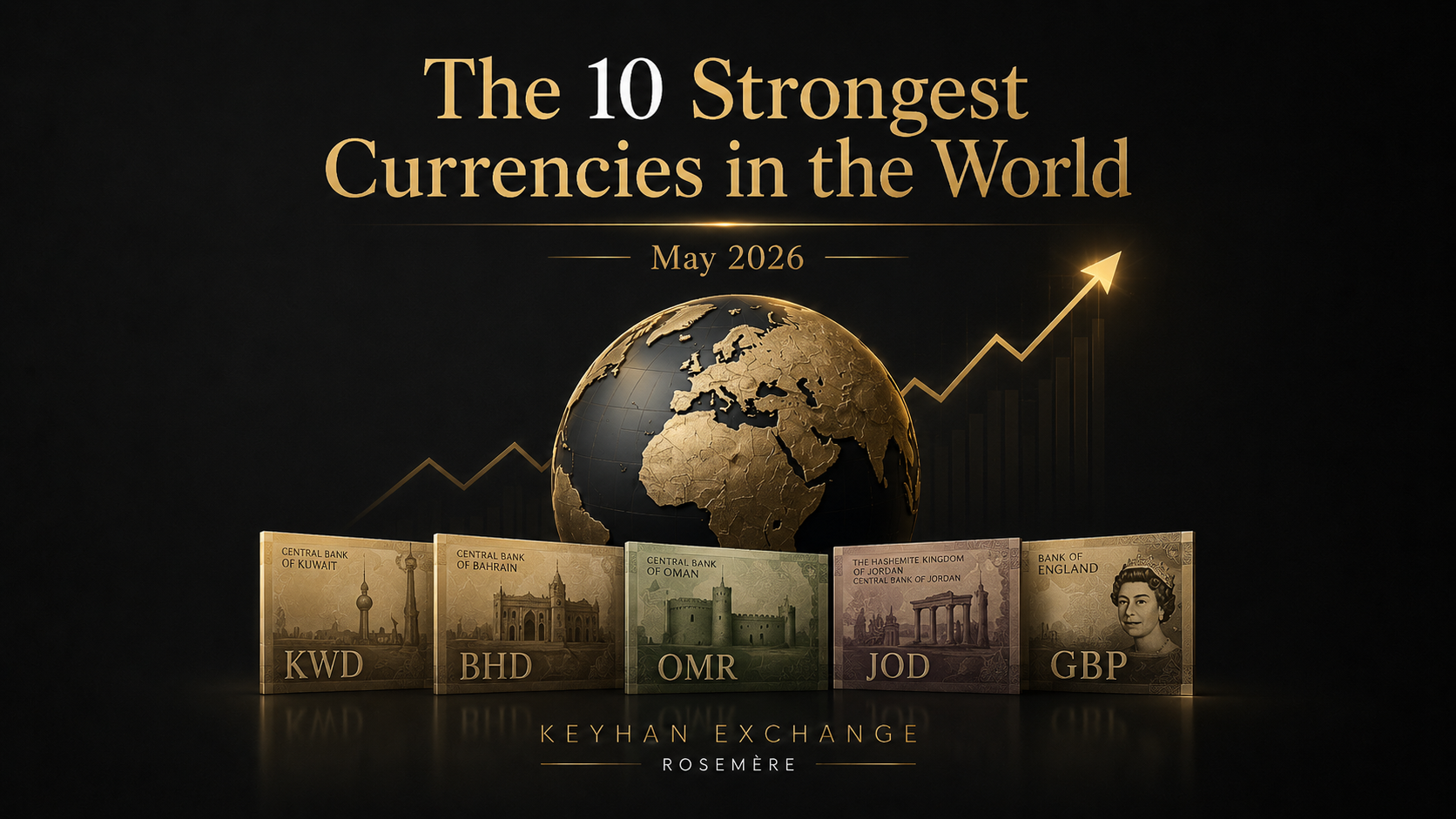
| # | Currency | Approx. USD | Why it ranks here |
|---|---|---|---|
| 1 | Kuwaiti Dinar (KWD) | ~$3.26 | Oil reserves, small population, conservative central bank |
| 2 | Bahraini Dinar (BHD) | ~$2.66 | USD peg since 1980, financial-hub banking sector |
| 3 | Omani Rial (OMR) | ~$2.60 | USD peg since 1986, oil exports |
| 4 | Jordanian Dinar (JOD) | ~$1.41 | USD peg since 1995, strong reserves, no oil |
| 5 | British Pound (GBP) | ~$1.35 | Free-floating, G7 economy, London financial centre |
| 6 | Swiss Franc (CHF) | ~$1.28 | Free-floating, safe-haven demand |
| 7 | Euro (EUR) | ~$1.17 | Free-floating, eurozone reserve currency |
| 8 | US Dollar (USD) | $1.00 | World's primary reserve currency; oil and gold pricing benchmark |
| 9 | Singapore Dollar (SGD) | ~$0.78 | Free-floating within a managed band, strong reserves, financial hub |
| 10 | Brunei Dollar (BND) | ~$0.78 | Pegged 1:1 to the Singapore dollar; oil and gas economy |
The US dollar sits at #8 because seven sovereign currencies are worth more than a dollar per unit. Everything below it, Singapore and Brunei included, is worth less than $1 per unit but still ranks above most of the world's currencies. The Canadian dollar, at around $0.73, lands just outside the top 10 once territorial currencies are excluded.
Why the same names always top this list
Four of the top five hold their spots through deliberate currency pegs or managed regimes, not raw market demand.
The Kuwaiti dinar isn't tied to the dollar alone. It's pegged to an undisclosed basket of currencies run by the Central Bank of Kuwait, an arrangement the bank went back to in May 2007 after a few years of pegging only to the dollar. Kuwait sits on one of the largest oil reserves in the world relative to its population of roughly 4.3 million, so oil revenue per person is enormous, and the central bank manages the dinar conservatively to protect that value. One historical note: after Iraqi forces looted banknotes during the 1990 invasion, Kuwait voided its third banknote series and issued a fourth one in March 1991. A full national currency reissue driven by war rather than inflation is a genuinely rare event.
The Bahraini dinar and Omani rial are both hard-pegged to the dollar, Bahrain since 1980 and Oman since 1986. (Oman first pegged in 1973 at a higher rate, then moved to today's $2.6008 in 1986.) Both economies still run on oil and gas, but Bahrain has built a real financial-services sector on top of that and positioned itself as a regional banking hub.
The Jordanian dinar is the odd one out, because Jordan has no meaningful oil or gas. Central Bank of Jordan figures show roughly $28.17 billion in gross foreign reserves at the end of February 2026, inflation near 1.11%, and a policy rate of 5.75%. High reserves, low inflation, and a relatively high policy rate have kept confidence in Jordan's fixed exchange-rate system, which has been in place since 1995. (The dinar is technically pegged to the IMF's Special Drawing Rights, but in practice it's held near 0.709 per dollar, about $1.41 per dinar, for three decades.) That's held up through a lot of regional turbulence.
The British pound is in this group for completely different reasons. It floats freely and isn't pegged to anything. Its value comes from where markets price UK interest rates, the depth of London as a financial centre, and confidence in UK government debt. That's also why, as Part 2 shows, it can lose value month to month while still ranking among the highest face-value currencies anywhere.
Part 2: May 2026's actual currency movers
This is the section that matters if you're sending money abroad, getting paid internationally, or just watching what your savings are worth. Below are the real percentage moves against the dollar for May 2026, calculated from the April 30 and May 29 Bloomberg closing rates reported by MUFG Research (5pm London time).
| Top gainers | vs USD |
|---|---|
| Russian Ruble (RUB) | +5.51% |
| South African Rand (ZAR) | +3.21% |
| Hungarian Forint (HUF) | +2.73% |
| Egyptian Pound (EGP) | +2.66% |
| New Zealand Dollar (NZD) | +1.73% |
| Chilean Peso (CLP) | +1.46% |
| Mexican Peso (MXN) | +1.04% |
| Taiwan Dollar (TWD) | +0.99% |
| Chinese Yuan (CNY) | +0.91% |
| Norwegian Krone (NOK) | +0.62% |
| Bottom performers | vs USD |
|---|---|
| Euro (EUR) | −0.38% |
| British Pound (GBP) | −0.71% |
| Canadian Dollar (CAD) | −1.23% |
| Romanian Leu (RON) | −1.50% |
| Brazilian Real (BRL) | −1.54% |
| Turkish Lira (TRY) | −1.55% |
| Japanese Yen (JPY) | −1.56% |
| South Korean Won (KRW) | −1.68% |
| Argentine Peso (ARS) | −2.12% |
| Indonesian Rupiah (IDR) | −3.00% |
For context, the dollar itself rose 0.9% in May on a DXY basis, partly reversing its April drop. So most of these currencies were gaining ground against a dollar that was itself getting stronger, which makes the ruble's run all the more notable.
There's one thing worth flagging about May in particular: the main driver changed. For most of early 2026, oil prices and risk sentiment ran the show. In May, MUFG notes, that pulled back and interest-rate spreads took over as the more traditional force in FX. The early-2026 oil shock is still the backdrop, but May's moves were increasingly about which central banks were hiking and which were sitting still.
The backdrop: the Strait of Hormuz
You can't make sense of 2026's currency markets without the energy story. The US-Iran war that started on February 28, 2026 led to the closure of the Strait of Hormuz, one of the most important oil chokepoints on the planet. The US Energy Information Administration reports that in 2024 and early 2025, flows through the strait accounted for more than a quarter of all seaborne oil trade and about a fifth of global oil and petroleum-product consumption. Closing it was a real supply shock.
That shock pushed Brent crude up roughly 15% in April. Then it fell close to 20% in May as optimism grew that a US-Iran ceasefire extension would reopen the strait, even though no final deal had been signed by the end of the month. That oil swing matters for a lot of the moves above, especially the energy-sensitive currencies. But it isn't the whole picture. Domestic data, central-bank policy, and rate expectations were also major drivers in May, and in some cases the bigger ones.
Why the Russian ruble was May's biggest winner (+5.51%)
This is the most counterintuitive result on the list. Russia is still under heavy Western sanctions, and its currency was still the best performer of the month, reaching roughly 70 to 71 per dollar in May, its strongest level since February 2023.
A few things drove it, and it's better to be precise than to reach for one tidy cause. Higher energy prices lifted Russia's export earnings. Chinese and Indian refiners kept buying Russian crude, which kept foreign currency flowing into the financial system. And Russia's capital controls and sanctions-suppressed import demand choke off the usual outflow of currency that would normally push the other way. MUFG ties the ruble's strength specifically to high energy prices, oil revenues, and rising Chinese and Indian purchases. Fewer rubles get converted into dollars or euros to pay for imports, so there's less downward pressure even while the money keeps coming in.
This isn't only MUFG's read. The Bank of Russia's own analyst survey and independent market trackers both flagged the ruble at its strongest since February 2023, pointing to the same mix of high energy prices and capital controls. When the issuer's own central bank survey, an independent data provider, and a foreign bank all land on the same explanation, you can be fairly confident in it.
The catch is that a strong ruble has actually hurt Russia's own budget. GDP shrank 0.2% year-on-year in the first quarter even as the currency climbed, because a stronger ruble cuts the ruble value of oil export revenue and squeezes the tax take from energy producers. A strong currency and a strong economy are not the same thing, and Russia in 2026 is about as clear an example of that gap as you'll come across.
Why the Japanese yen was the worst-performing G10 currency in May
USD/JPY went from 156.66 to 159.15 over the month, and MUFG flagged the yen as the worst-performing G10 currency in May. That's remarkable considering Japan's Ministry of Finance confirmed it spent ¥11.7 trillion buying yen between April 28 and May 27 — tens of billions of dollars spent propping up the currency, and it still ended the month weaker.
MUFG read the quick rebound in USD/JPY off the intervention lows as a sign the support hadn't taken, against a backdrop the authorities can't control: rising global bond yields and high energy prices both work against the yen. This is a widely shared view, not one bank's take. Reporting that traced the intervention through Japan's central-bank accounts reached the same conclusion, and strategists at other global banks have made the same structural point for a while now. Until Japan's real interest rates stop being deeply negative, intervention can produce sharp but short-lived yen rallies rather than a real turn.
The root of it is interest rates. The Bank of Japan's policy rate is just 0.75%, even after a rare hike in December 2025, and adjusted for inflation that rate is still well below zero. Japan's 10-year government bond yield rose 14 basis points in May to close at 2.67%, its highest monthly close since 1997, and yet the BoJ is still moving carefully on rate hikes compared with the rest of the world. That gap is what traders are pricing into the yen.
Why the British pound slipped despite being a "top 5" currency
This is the contrast that makes Part 1 and Part 2 worth reading together. The pound is the fifth most valuable currency in the world by face value, and it was still the third worst-performing G10 currency in May, falling from 1.3578 to 1.3481 against the dollar.
The reason was mostly a shift in rate expectations, not oil. UK data came in soft in May. Both inflation and the jobs numbers undershot forecasts, including a reported 100,000 drop in April employment, and that pushed back expectations for Bank of England rate hikes. Layer on political uncertainty around Prime Minister Starmer's weakened position, and investors had reasons to sell sterling even with its absolute value still high.
Independent market commentary in mid-May landed on the same read, and on its more interesting wrinkle: the pound was weakening even though markets still expected the Bank of England to tighten further, which is unusual. Analysts put that down to worries about UK fiscal credibility and political stability rather than rate differentials, which would normally have supported the currency. Face value tells you what a currency is worth right now. The monthly move tells you which way it's heading. The pound managed to be expensive and falling at the same time in May 2026.
What this means for you
If you're exchanging currency, here's the pattern from May. Several emerging-market and commodity-linked currencies, the ruble and the rand among them, came out ahead, while two currencies people usually file under "strong," the yen and the pound, lagged. That's close to the opposite of what intuition would suggest, and it only shows up when you track actual monthly moves instead of leaning on a "strongest currencies" list that barely budges from year to year.
The drivers were mixed. The early-2026 oil shock was still in the background, but rate expectations, domestic data, and country-specific policy increasingly took the lead. No single event explains every move, and any month where someone tells you it does is a month worth a second look.
Rate disclaimer: The monthly percentage changes in this article come from a single consistent source, MUFG Research's Bloomberg closing rates (5pm London time), measured from the April 30 month-end close to the May 29 month-end close. The surrounding analysis draws on additional sources, including the central banks of Bahrain, Oman, Jordan, Kuwait, and Russia, the US Energy Information Administration, and other major banks' currency research. Figures measured over different date ranges, or using a different provider's snapshot time, may differ slightly — this reflects differing methodology, not conflicting data. Face-value rates are approximate reference values. Exchange rates move constantly; for current rates, visit a Keyhan Exchange location.
Keyhan Exchange — Currency Exchange in Rosemère
Located at 219 boulevard Labelle, Rosemère, on Montreal's North Shore. We serve clients from Laval, Boisbriand, Sainte-Thérèse, Blainville and the surrounding cities.
Currency payments are accepted in cash or by regular debit card only; Visa and Mastercard are not accepted. Regular debit payments under CA$500 have a CA$5 flat fee. At CA$500 or more, a 1% adjustment applies to the offered exchange rate, included once and not added again as a separate fee. The threshold is based on the transaction's Canadian-dollar value before the debit-payment adjustment. Gold transactions are cash only.
- Over 50 foreign currencies
- No fees or commission on cash currency exchanges
- Rates updated regularly
- Bilingual service FR / EN
- Fast transactions in minutes
- Open 7 days a week
- 300+ five-star Google reviews
- Cash or regular debit for currency payments
Compare our rate today — come see us in Rosemère
See today's rates